

Sort by
CJMCU-103 Rotary Angle Sensor…
CJMCU-103 Rotary Angle Sensor Potentiometer Module
The CJMCU-103 is a rotary angle sensor module that measures the angular position of a shaft or other rotating object using a potentiometer. A potentiometer is a sort of variable resistor that can be used to measure a shaft's location by altering the resistance as the shaft rotates. A potentiometer is commonly attached to the shaft, and an integrated circuit (IC) turns the potentiometer's resistance into a voltage or digital signal that can be read by a microcontroller or other device.
The CJMCU-103 is a low-power, compact device with a wide range of system integration options. It can be used to calculate the angle of a steering wheel, regulate the movement of a robot arm, or detect the angular location of a motor shaft.
MCU-103 Rotation Angle
Sensor
has a dustproof design that protects the interior from dust, which maintains stable performance. It is compatible with high peak lead-free soldering. temperatures.
Applications:
Used in Switch for automotive, Motor drive unit, Radio control equipment, Electric motor-driven bicycle, etc
₹132,08
MRP. ₹320,60
Incl. GST (No Hidden Charges)
Incl. GST (No Hidden Charges)


CJMCU-103 Rotary Angle Sensor Potentiometer Module
CJMCU-103 Rotary Angle Sensor Potentiometer Module The CJMCU-103 is a rotary angle sensor module that measures the angular position of a shaft or other rotating object using a potentiometer. A …
As low as
₹132,08
₹132,08
MRP. ₹320,60
Incl. GST (No Hidden Charges)
CJMCU-6701 GSR Skin Sensor Mo…
CJMCU-6701 GSR Skin Sensor Module Analog SPI 3.3V/5V
The CJMCU-6701 GSR Skin Sensor Module is a biosensor module that measures the electrical conductance of the skin, also known as the Galvanic Skin Response (GSR). The module can be used to monitor changes in skin electrical conductance as a result of stress, emotions, or other physiological circumstances. This has a wide range of applications, including deception detection, human-computer interaction, and stress monitoring.
The module is available in Analog, SPI, and 3.3V/5V versions, allowing it to be integrated into systems using 3.3V or 5V voltage and communicating with the microcontroller via the SPI protocol. The module is small in size and can be used in various other of applications.
The working principle of the GSR sensor is based on the fact that the electrical conductance of the skin changes based on the level of sweat production. Sweat production is influenced by the level of emotional or physical arousal, thus changes in conductance can be used to infer changes in emotional or physiological states. GSR
sensor
clicks are ideally suited as an experimental tool for research, as well as for establishing effective test applications based on EDA reactions - such as polygraphs.
₹903,21
MRP. ₹1398,60
Incl. GST (No Hidden Charges)
Incl. GST (No Hidden Charges)


CJMCU-6701 GSR Skin Sensor Module Analog SPI 3.3V/5V
CJMCU-6701 GSR Skin Sensor Module Analog SPI 3.3V/5V The CJMCU-6701 GSR Skin Sensor Module is a biosensor module that measures the electrical conductance of the skin, also known as the …
As low as
₹903,21
₹903,21
MRP. ₹1398,60
Incl. GST (No Hidden Charges)

CMOS 8-Input NAND/AND Gate IC…
CMOS 8-Input NAND/AND Gate IC - CD4068
The CD4068 CMOS 8-Input NAND/AND gate IC (Integrated Circuits) provides the system designer with direct implementation of the positive logic 8-Input NAND and AND functions and supplements the existing family of CMOS gates.
The
CD4x Series
CD4068 is an 8-Input NAND/AND Gate CMOS logic-based IC belonging to a CD4000 series of integrated circuits. Firstly, Two output options are available such as AND and NAND gate. Secondly, the same input pins deliver both logical functions. It is available in a variety of packages which includes 14-pin PDIP, GDIP, PDSO. The typical operating voltage of the IC is +5V, but it can also be operated +10V and +15V. It has a standard symmetric output. This IC is useful for applications requiring low power. Furthermore, it offers a wide voltage operating range.
check out :
CMOS Hex Buffers/Converter IC - CD4009
Pinout:
Pinout of CD4068
₹25,39
MRP. ₹54,60
Incl. GST (No Hidden Charges)
Incl. GST (No Hidden Charges)
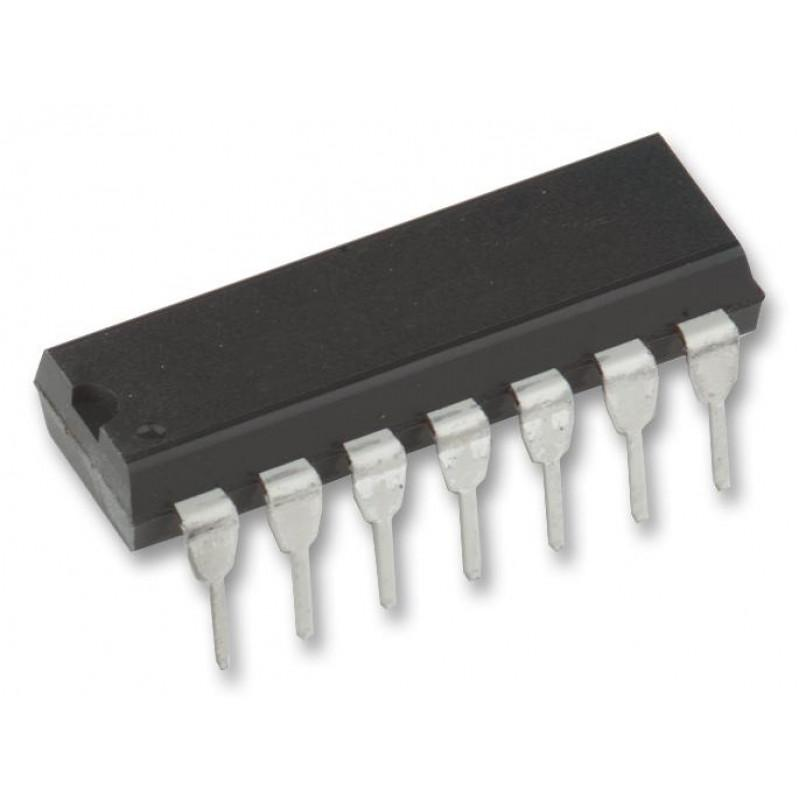
CMOS 8-Input NAND/AND Gate IC - CD4068
CMOS 8-Input NAND/AND Gate IC - CD4068 The CD4068 CMOS 8-Input NAND/AND gate IC (Integrated Circuits) provides the system designer with direct implementation of the positive logic 8-Input NAND and …
As low as
₹25,39
₹25,39
MRP. ₹54,60
Incl. GST (No Hidden Charges)
CMOS Hex Buffers/Converter IC…
CMOS Hex Buffers/Converter IC - CD4009
CD4009 Hex Buffer/Converters may be used as CMOS to TTL or DTL logic-level converters or CMOS high-sink-current drivers.
The CD4009 types are supplied in 16-lead hermetic dual-in-line ceramic packages (F3A suffix), 16-lead dual-in-line plastic packages (E suffix).
check out :
CMOS 8-Input NAND/AND Gate IC - CD4068
Applications:
CMOS to DTL/TTL hex converter
CMOS current "sink" or "source" driver
CMOS high-to-low logic-level converter
Multiplexer — 1 to 6 or 6 to 1
check out :
Hex Buffer/Converter IC - CD4010
₹27,43
MRP. ₹47,60
Incl. GST (No Hidden Charges)
Incl. GST (No Hidden Charges)
CMOS Hex Buffers/Converter IC - CD4009
CMOS Hex Buffers/Converter IC - CD4009 CD4009 Hex Buffer/Converters may be used as CMOS to TTL or DTL logic-level converters or CMOS high-sink-current drivers. The CD4009 types are supplied in …
As low as
₹27,43
₹27,43
MRP. ₹47,60
Incl. GST (No Hidden Charges)
Coin type battery holder 24mm
Coin type battery holder 24mm
This is a coin cell battery holder. It's fast, cheap, reliable, and works on all sizes and shapes of coin cells. The holder can be easily taped, glued, soldered, or bolted to a project. It even has built-in holes for sewing into wearable electronic fashions. And best of all it can be made with stuff you probably have on hand.
A button
battery
holder adapted to be inserted into electronic equipment is disclosed. As the
battery holder
is mounted into the electronic equipment in the direction parallel to the electrode surfaces of the button battery, a battery holder insert hole and a battery holder mounting portion to be formed in the electronic equipment can be made small, thereby contributing to a reduction in the size of the electronic equipment.
Applications:
Portable Devices
Computers & Computer Peripherals
Consumer Electronics
Power Management
Commercial
Security
₹11,17
MRP. ₹33,60
Incl. GST (No Hidden Charges)
Incl. GST (No Hidden Charges)


Coin type battery holder 24mm
Coin type battery holder 24mm This is a coin cell battery holder. It's fast, cheap, reliable, and works on all sizes and shapes of coin cells. The holder can be …
As low as
₹11,17
₹11,17
MRP. ₹33,60
Incl. GST (No Hidden Charges)
Coin Type Micro Vibration Mot…
Coin Type Micro Vibration Motor
This Flat 1034 Mobile Phone Vibration Motor is a shaftless vibration motor which is fully-enclosed with no exposed moving parts. Its small size (10 mm diameter, 3.4 mm height) and shaftless design mean you can mount it on a PCB or even place it in a pocket to add quiet, haptic feedback to your project.
The
motor
has a 3M adhesive backing on it for easy mounting and 1.5? leads for making quick connections. Polarity is not important; the motor can run CW or CCW.
This tiny, button-type, vibrating motor shakes with a vibration amplitude of 0.75g and draws approximately 60 mA when 3 V is applied to its leads.
Features:
Size: Approximately 10mm in diameter and 2-3mm in thickness.
Voltage: Operates on 3V DC.
Speed: Can reach up to 12,000 RPM.
Type: Eccentric Rotating Mass (ERM) motor, which creates vibration by rotating an off-center mass.
Mounting: Compact and convenient to use, with options for self-adhesive mounting.
Noise Level: Low noise level when vibrating.
Applications: Suitable for mobile phones, pagers, handheld devices, wearables, and other electronics requiring vibration feedback123.
Applications:
Mobile phones
Toys, health products
Handicrafts
Electronic products
Medical equipment
Tablet computers
Wearable devices
Smartwatches
Structure of Coin Type Micro Vibration Motor
₹20,32
MRP. ₹42,00
Incl. GST (No Hidden Charges)
Incl. GST (No Hidden Charges)


Coin Type Micro Vibration Motor
Coin Type Micro Vibration Motor This Flat 1034 Mobile Phone Vibration Motor is a shaftless vibration motor which is fully-enclosed with no exposed moving parts. Its small size (10 mm …
As low as
₹20,32
₹20,32
MRP. ₹42,00
Incl. GST (No Hidden Charges)
Color Recognition Sensor Modu…
Color Recognition Sensor Module TCS3200D/TCS2300
The TCS3200 Color Recognition Sensor Module uses a high-quality light sensor allowing you to sense any color through a combination of Red, Green, and Blue. The module provides all of the pins of the TCS3200 on convenient 0.1? headers – ideal for use with PCBs, breadboard or stripboard.
Four white LEDs provide plenty of light for the
color sensor
and allow you to use the module in any ambient light.
The
sensor module
requires only a single supply voltage between 2.7V and 5.5V – making it compatible with nearly all common microcontrollers, including PICs, AVRs, ARM,Arduino and more.
Header one on the left side of the board
S0: Output frequency scaling selection input (along with S1)
S1: Output frequency scaling selection input (along with S0)
OE: Output Enable – if held low, the output of the module is turned on
GND: Ground – connect to 0V
Header two on the right side of the board
S3: Photodiode type (along with S2)
S2: Photodiode type (along with S3)
OUT: Output – A square wave appears here showing the intensity of the detected colour
VCC: Power – connect to 2.7V-5.5V
₹344,42
MRP. ₹768,60
Incl. GST (No Hidden Charges)
Incl. GST (No Hidden Charges)


Color Recognition Sensor Module TCS3200D/TCS2300
Color Recognition Sensor Module TCS3200D/TCS2300 The TCS3200 Color Recognition Sensor Module uses a high-quality light sensor allowing you to sense any color through a combination of Red, Green, and Blue. …
As low as
₹344,42
₹344,42
MRP. ₹768,60
Incl. GST (No Hidden Charges)
Colour Sensor
Colour Sensor
A colour sensor is a device that detects and measures an object's or surface's colour. Color sensors measure the amount of light reflected or transmitted by an object in various wavelength bands. RGB (red, green, blue) sensors detect the intensity of light in the red, green, and blue areas of the spectrum, whereas CMYK (cyan, magenta, yellow, black) sensors measure the intensity of light in the cyan, magenta, yellow, and black regions of the spectrum.
White light is a mixture of three basic colors known as primary colors. They are red, blue and green. These colors have different wavelengths. Combinations of these colors at different proportions create different types of colors. When the white light falls on any surface, some of the wavelengths of the light are absorbed by the surface while some are reflected back based on the properties of the surface material.
Colour of the material is detected when these reflected wavelengths fall on the human eye. A material reflecting wavelengths of red light appears as red. The component used to detect colors is the Color
sensor
.
What is a Color Sensor?
A color sensor detects the color of the material. This sensor usually detects color in RBG scale. This sensor can categorize the color as red, blue or green. These sensors are also equipped with filters to reject the unwanted IR light and UV light.
Working Principle of Color Sensor
To detect the color of material three main types of equipment are required. A light source to illuminate the material surface, a surface whose color has to be detected and the receivers which can measure the reflected wavelengths.
Colour sensors
contain a white light emitter to illuminate the surface. Three filters with wavelength sensitivities at 580nm, 540nm, 450nm to measure the wavelengths of red, green and blue colors respectively.
Applications:
Ensures accurate color in printing and packaging processes.
Checks color consistency in food to maintain product quality.
Matches colors in fabric and yarn production.
Adjusts colors in cameras and displays for better images.
Helps robots recognize objects based on color for automation.
Matches colors in fabric and yarn production.
₹367,78
MRP. ₹698,60
Incl. GST (No Hidden Charges)
Incl. GST (No Hidden Charges)


Colour Sensor
Colour Sensor A colour sensor is a device that detects and measures an object's or surface's colour. Color sensors measure the amount of light reflected or transmitted by an object …
As low as
₹367,78
₹367,78
MRP. ₹698,60
Incl. GST (No Hidden Charges)
Combo of W1209 Digital Thermo…
W1209 with 12V Adapter, DC Fan, DC female Jack and Alligator Clips
The combo of a W1209 digital thermostat temperature controller with a 12V 2AMP adapter, a 12V DC 0.15A fan, a DC female jack/splitter, and alligator clips is a package of components that can be used to build a temperature control system. The W1209 digital thermostat controller is a standalone device that allows you to control the temperature of a system or process using a digital interface. It includes a temperature sensor, a control algorithm, and an output mechanism to control the temperature. The 12V 2AMP adapter is a power supply that converts AC power to 12V DC power, which is used to power the controller and other components.
The 12V DC 0.15A fan is a small cooling fan that can be used to dissipate heat from the system. The DC female jack/splitter is a connector that allows you to split a single DC power source into multiple outputs. The alligator clips are used to make temporary electrical connections. Together, these components can be used to build a temperature control system for a wide range of applications including HVAC systems, incubators, ovens, and other temperature-controlled environments.
₹393,19
MRP. ₹642,60
Incl. GST (No Hidden Charges)
Incl. GST (No Hidden Charges)


Combo of W1209 Digital Thermostat Temperature Controller with 12V 2AMP Adapter, 12V DC 0.15A Fan, DC female Jack/Splitter and Alligator Clips
W1209 with 12V Adapter, DC Fan, DC female Jack and Alligator Clips The combo of a W1209 digital thermostat temperature controller with a 12V 2AMP adapter, a 12V DC 0.15A …
As low as
₹393,19
₹393,19
MRP. ₹642,60
Incl. GST (No Hidden Charges)
Common Ground Point 2 pin
Common Ground Point 2 pin
In electrical engineering, ground or earth is the reference point in an electrical circuit from which voltages are measured, a common return path for electric current, or a direct physical connection to the earth. Electrical circuits may be connected to ground (earth) for several reasons.
₹150,37
MRP. ₹322,00
Incl. GST (No Hidden Charges)
Incl. GST (No Hidden Charges)


Common Ground Point 2 pin
Common Ground Point 2 pin In electrical engineering, ground or earth is the reference point in an electrical circuit from which voltages are measured, a common return path for electric …
As low as
₹150,37
₹150,37
MRP. ₹322,00
Incl. GST (No Hidden Charges)
