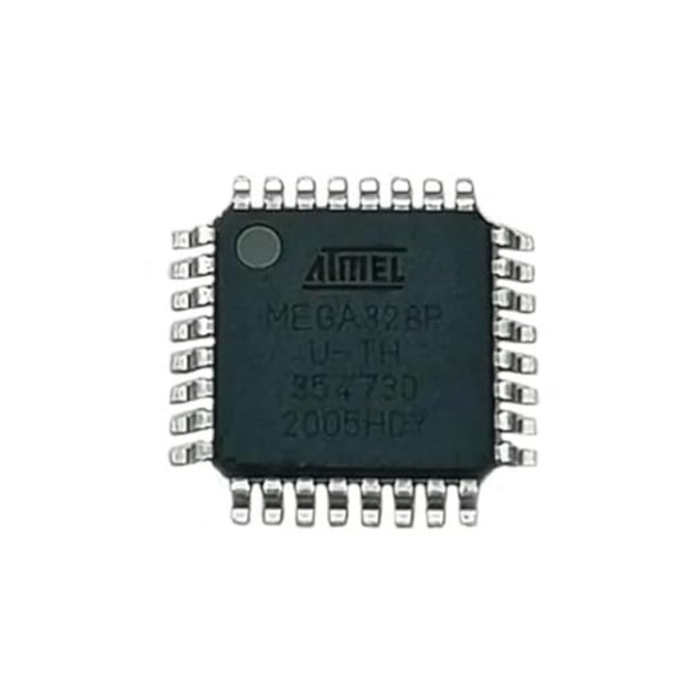
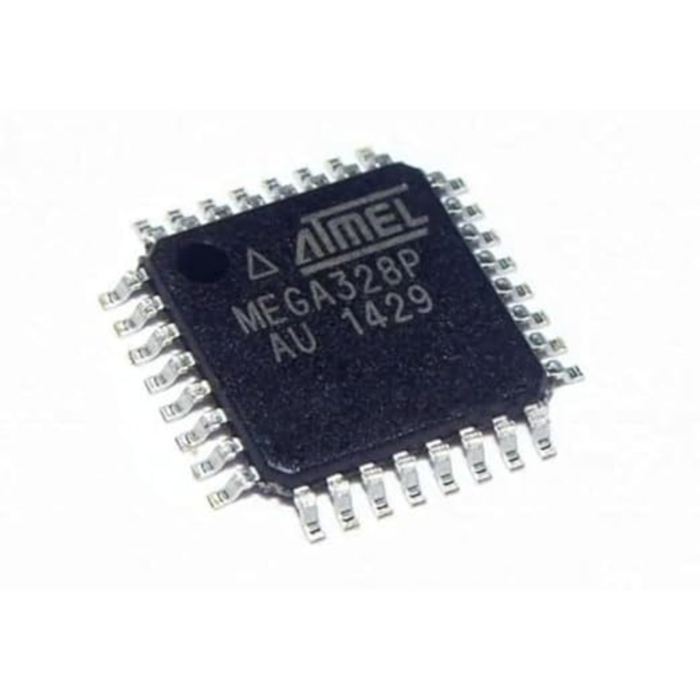
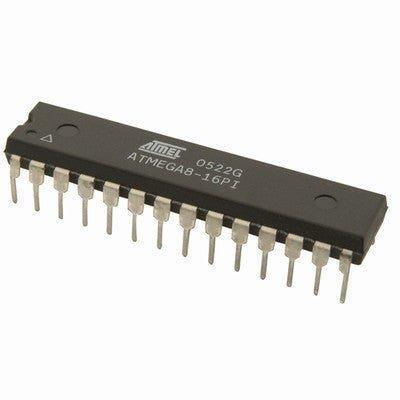
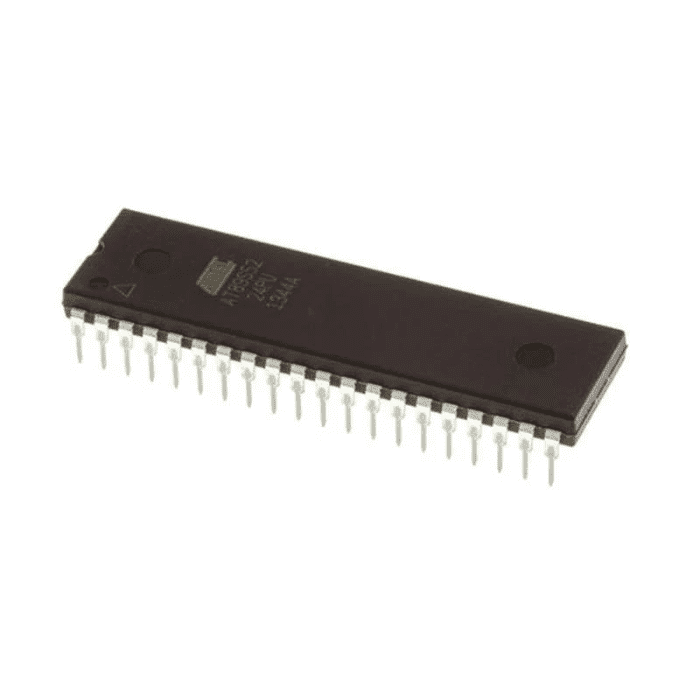
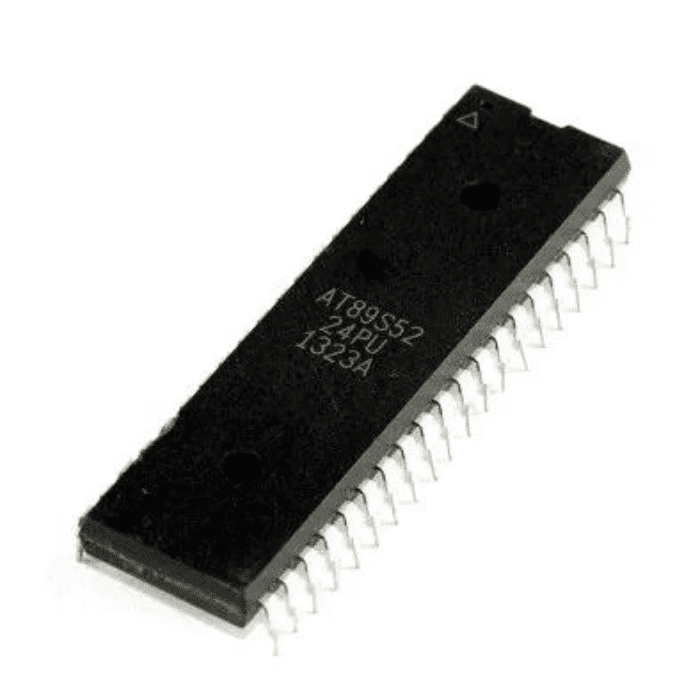
ATmega16
Only 4 items in stock. Additional quantity can be backordered.
Delivery & Pickup Options
Order now and we'll have it ready for delivery by the next business day.
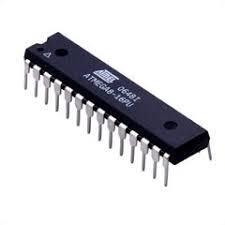
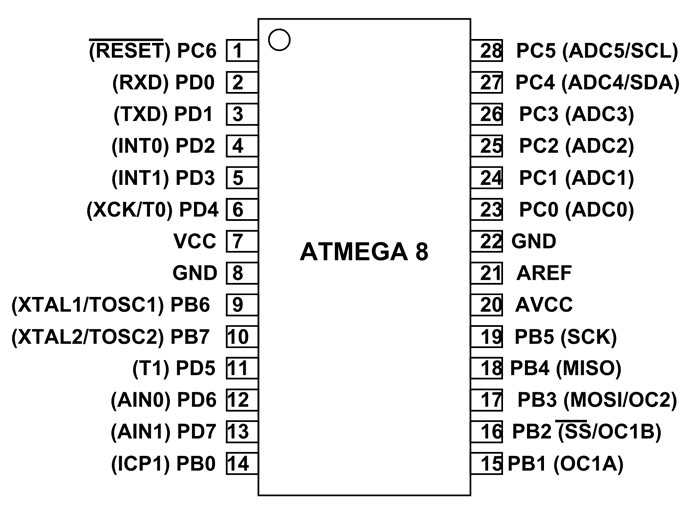
ATmega16 The ATmega ATmega16 is a low-power CMOS 8-bit microcontroller based on the AVR enhanced RISC architecture. By executing powerful instructions in a single clock cycle, the ATmega16 achieves throughputs approaching 1 MIPS per MHz allowing the system designer to optimize power consumption versus processing speed. Pinout: Pinout of ATmega16 1 PB0(XCK/T0) Pin 0 of PORTB T0( Timer0 External Counter Input) XCK ( USART External Clock I/O) 2 PB1(T1) Pin 1 of PORTB T1(Timer1 External Counter Input) 3 PB2(INT2/AIN0) Pin 2 of PORTB AIN0(Internal Analog Comparator Positive Input) INT2( External Interrupt 2 Input) 4 PB3(OC0/AIN1) Pin 3 of PORTB AIN1(Internal Analog Comparator Negative Input) OC0 (Timer0 Output Compare Match Output) or PWM output 5 PB4(SS ) Pin 4 of PORTB SS (SPI Slave Select Input). This pin is low when controller acts as slave. [Serial Peripheral Interface (SPI) for programming] 6 PB5(MOSI) Pin 5 of PORTB MOSI (Master Output Slave Input). When controller acts as slave, the data is received by this pin. [Serial Peripheral Interface (SPI) for programming] 7 PB6(MISO) Pin 6 of PORTB MISO (Master Input Slave Output). When controller acts as slave, the data is sent to master through this pin. [Serial Peripheral Interface (SPI) for programming] 8 PB7(SCK) Pin 7 of PORTB SCK (SPI Bus Serial Clock). This is the clock shared between this controller and other system for accurate data transfer. [Serial Peripheral Interface (SPI) for programming] 9 RESET Reset Pin (Active Low Reset) 10 VCC Connected to +5V 11 GND Connected to GROUND 12 XTAL2 Connected to Crystal Oscillator 13 XTAL1 Connected to Crystal Oscillator 14 PD0(RXD) Pin 0 of PORTD RXD (USART Input Pin) [USART Serial Communication Interface can be used for programming] 15 PD1(TXD) Pin 1 of PORTD TXD (USART Output Pin) [USART Serial Communication Interface can be used for programming] 16 PD2(INT0) Pin 2 of PORTD External Interrupt INT0 17 PD3(INT1) Pin 3 of PORTD External Interrupt INT1 18 PD4(OC1B) Pin 4 of PORTD OC1B (Timer Output Compare Match Output) or PWM output 19 PD5(OC1A) Pin 5 of PORTD OC1A (Timer Output Compare Match Output) or PWM output 20 PD6(ICP) Pin 6 of PORTD Timer/Counter1 Input Capture Pin 21 PD7 (OC2) Pin 7 of PORTD Timer/Counter2 Output Compare Match Output 22 PC0 (SCL) Pin 0 of PORTC TWI Interface 23 PC1 (SDA) Pin 1 of PORTC TWI Interface 24 PC2 (TCK) Pin 2 of PORTC JTAG Interface 25 PC3 (TMS) Pin 3 of PORTC JTAG Interface 26 PC4 (TDO) Pin 4 of PORTC JTAG Interface 27 PC5 (TDI) Pin 5 of PORTC JTAG Interface 28 PC6 (TOSC1) Pin 6 of PORTC Timer Oscillator Pin 1 29 PC7 (TOSC2) Pin 7 of PORTC Timer Oscillator Pin 2 30 AVcc Vcc for Internal ADC Converter 31 GND GROUND 32 AREF Analog Reference Pin for ADC 33 PA7 (ADC7) Pin 7 of PORTA ADC (Analog to Digital Converter) Channel 7 34 PA6 (ADC6) Pin 6 of PORTA ADC (Analog to Digital Converter) Channel 6 35 PA5 (ADC5) Pin 5 of PORTA ADC (Analog to Digital Converter) Channel 5 36 PA4 (ADC4) Pin 4 of PORTA ADC (Analog to Digital Converter) Channel 4 37 PA3 (ADC3) Pin 3 of PORTA ADC (Analog to Digital Converter) Channel 3 38 PA2 (ADC2) Pin 2 of PORTA ADC (Analog to Digital Converter) Channel 2 39 PA1 (ADC1) Pin 1 of PORTA ADC (Analog to Digital Converter) Channel 1 40 PA0 (ADC0) Pin 0 of PORTA ADC (Analog to Digital Converter) Channel 0 Applications: Hobbyists applications Engineers design Temperature control systems Analog signal measuring and manipulations. Embedded systems like coffee machine, vending machine. Motor control systems. Digital signal processing. Peripheral Interface system.
- High-performance, Low-power Atmel® AVR® 8-bit Microcontroller
- Advanced RISC Architecture
- High Endurance Non-volatile Memory segments
- JTAG (IEEE std. 1149.1 Compliant) Interface
- Operating Voltages: 2.7V - 5.5V for ATmega16L 4.5V - 5.5V for ATmega16
- 2.7V - 5.5V for ATmega16L
- 4.5V - 5.5V for ATmega16
- Speed Grades:0 - 8 MHz for ATmega16L0 - 16 MHz for ATmega16
- 0 - 8 MHz for ATmega16L
- 0 - 16 MHz for ATmega16
- Power Consumption @ 1 MHz, 3V, and 25°C for ATmega16LActive: 1.1 mAIdle Mode: 0.35 mAPower-down Mode: < 1 µA
- Active: 1.1 mA
- Idle Mode: 0.35 mA
- Power-down Mode: < 1 µA
| CPU | 8-bit AVR |
|---|---|
| Number of Pins | 40 |
| Operating Voltage | For ATMEGA16:+4.5 to +5.5 V (+5.5V being absolute maximum) For ATMEGA16L:+2.7 to 5.5V(+5.5V being absolute maximum) |
| Number of Input/output pins | 32 |
| Communication Interface | JTAG Interface(24,25,26,27 PINS)[Can be used for programming this controller] SPI Serial Interface(5,6,7,8 PINS) [Can be used for programming this controller] Programmable Serial USART(14,15 PINS) [Can be used for programming this controller] Two-wire Serial Interface(22,23 PINS)[Can be used to connect peripheral devices like sensors and servos] |
| ADC Module | 8 channels , 10-bit resolution ADC |
| Timer Module | Two 8-bit counters, One 16-bit counter [Total three] |
| Analog Comparators | 1 |
| DAC Module | Nil |
| PWM channels | 4 |
| External Oscillator | 0-8MHz for ATMEGA16L 0-16MHz for ATMEGA16 |
| Internal Oscillator | 0-8MHz Calibrated Internal Oscillator |
| Program Memory Type | Flash |
| Program Memory | 16Kbytes[10000 write/erase cycles] |
| CPU Speed | 16 MIPS |
| RAM Bytes | 1KBytes |
| Data EEPROM | 512 Bytes |
| Operating Temperature | -55°C to +125°C(+125 being absolute maximum, -55 being absolute minimum) |
| Dimensions | 34x7x4mm |
| Weight | 2g |
No FAQs available for this product yet.
To rate this product please login!
About ATmega16 by Iotcart
Shop ATmega16 by Iotcart at best price in India. Fast delivery, genuine quality, and secure checkout.
Categorised under: Basic Components› 8051, ARM, PIC, AVR› Atmega IC